Korea's Glorified Snow White Gold
Ask a Korean what comfort food means to them, and there's a good chance the answer is seolleongtang (설렁탕). This milky white beef bone soup is served in homes, late-night restaurants, and neighborhood diners across Korea. But behind the humble bowl is a story that reaches back centuries, to a royal ceremony, a king, and a crowd that needed to be fed.
You may also have seen it spelled sul lung tang or seollongtang. Whatever you call it, here's everything you need to know about this savory, delicious soup.
What Is Seolleongtang?
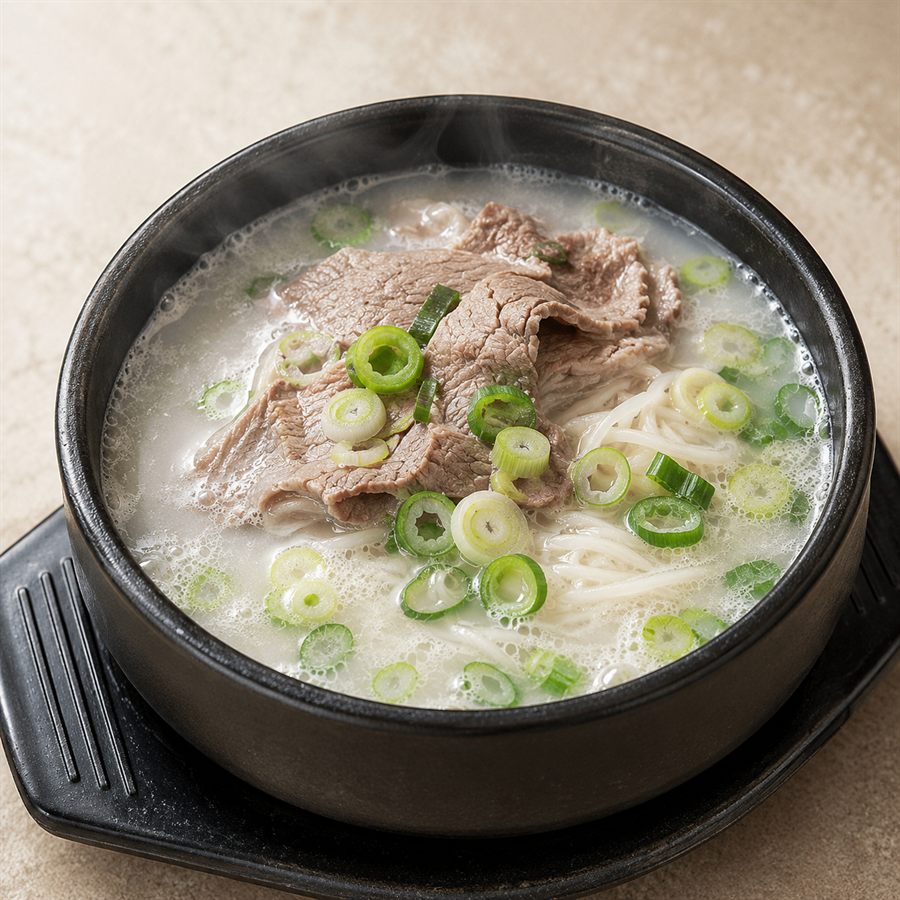
Seolleongtang is a Korean soup made by boiling ox bones for many hours until the broth turns a rich, milky white. It's typically served with thin slices of tender beef, soft somyeon noodles, and a handful of chopped green onions.
What surprises many first-timers is that the soup comes to the table without seasoning. Each diner adds salt and pepper to taste, so no two bowls end up quite the same.
The name is often written with the Chinese characters 雪濃湯, which translate to "snow-thick soup." It's a fitting description of its creamy white color, although many historians believe the characters were attached to the name later rather than being its true origin.
Where Did Seolleongtang Come From?
No one knows for certain. There are two popular theories, and each one tells us something about Korea's past.
The Royal Legend: King Seongjong and Seonnongdan
The best-known story takes place during the Joseon Dynasty. Joseon kings held a yearly ceremony called Seonnongje (선농제) at an altar in Seoul known as Seonnongdan. The ceremony honored the legendary gods of agriculture, and the king prayed there for a good harvest. After the rites, the king would even plow a field himself to show respect for farming and the people who worked the land.
According to legend, King Seongjong, who reigned from 1469 to 1494, attended the ceremony when a large crowd had gathered. With so many people to feed, he ordered that the sacrificed cattle be boiled in enormous pots of water, making a soup that could stretch to feed everyone. The soup of Seonnongdan, "Seonnong-tang," is said to have gradually become the name we know today: seolleongtang.
The Mongol Theory
A second theory reaches back even further, to the 13th century, when the Mongol Empire invaded Korea. The Mongols brought their own food traditions with them, including shülen, a simple dish of meat boiled in water. Some scholars believe the Korean word seolleongtang grew out of this Mongolian word, and that the soup developed from Mongol cooking during that period.
Which Story Is True?
Historians still debate it, and both stories continue to be told today. The royal legend is the more famous one, while the Mongol theory has strong support from language researchers. What everyone agrees on is that seolleongtang has been part of Korean food culture for centuries, feeding kings and working people alike.
Seolleongtang in Everyday Korean Life
By the early 1900s, seolleongtang shops had spread throughout Seoul. The soup was affordable, filling, and fast, making it one of the most popular meals for working people in the city.
It even appears in one of Korea's most famous short stories. In Hyun Jin-geon's 1924 story A Lucky Day (운수 좋은 날), a poor rickshaw puller has an unusually good day of work, and he uses his earnings to buy seolleongtang for his sick wife, who has been craving it. Generations of Korean students have read the story in school, and it shows how closely the soup is tied to taking care of the people we love.
Today, seolleongtang is still everywhere in Korea. Many restaurants stay open 24 hours, and it's a go-to meal on cold mornings, after a long night out, or whenever someone is feeling under the weather.
How Is Seolleongtang Made?
Great seolleongtang takes time and patience. The process begins by soaking the ox bones in cold water to draw out the blood, then blanching them to remove impurities. The cleaned bones are then boiled for 72 hours, and many kitchens repeat the process in several batches to build a deeper broth.
The secret to its milky color is the boil itself. Unlike Vietnamese pho or French consommé, which are gently simmered to keep the broth clear, seolleongtang is cooked at a strong, rolling boil. That constant movement breaks down the fat, marrow, and collagen from the bones and blends them into the water, turning the broth white and giving it a rich, silky body.
It's hard work. The pot has to be watched, skimmed, and topped up throughout the day, which is why a truly good bowl of seolleongtang is something to appreciate.
Why Does Seolleongtang Taste Bland?
Seolleongtang tastes bland at first because it's served unseasoned on purpose. It's up to you to add sea salt and black pepper at the table.
This tradition exists for a simple reason: everyone likes a different amount of salt. Seasoning the broth in the kitchen would decide that for you and could cover up the natural beefy flavor of the soup.
If it's your first time, add a small pinch of salt, stir, and taste. Keep adjusting until the flavor opens up. Most people are surprised by how much a little seasoning brings the broth to life.
How to Eat Seolleongtang Like a Korean
To enjoy your bowl the way Koreans do, start by seasoning it with salt and pepper. Then add the chopped green onions, which give the rich broth a fresh, sharp bite.
Next comes the rice. Many Koreans put their rice straight into the soup and let it soak up the broth. Others prefer to eat it on the side, one spoonful at a time.
Finally, don't skip the kimchi. Seolleongtang is traditionally served with napa cabbage kimchi and kkakdugi, a crunchy radish kimchi. The tangy, spicy kimchi balances the mild broth perfectly, and some people even pour a little kkakdugi juice into their soup for extra flavor.
Is Seolleongtang Healthy?
Seolleongtang is a hearty, nourishing meal. It's a good source of protein, and the long boiling process draws collagen and gelatin out of the bones and into the broth. The warm soup is also easy on the stomach, which is part of why it's so popular on cold days.
In Korea, seolleongtang has long been a traditional food for regaining energy, whether someone is recovering from a cold, a hard day of work, or a late night. It's the kind of meal that simply makes you feel better.
Jang Dok Dae Seolleongtang (설렁탕)
At Jang Dok Dae, we've been serving Duluth's Korean community and neighbors since 2008, and seolleongtang has been part of our kitchen from the start. Our broth is made from grass-fed ox bones boiled for 72 hours, and we use a special water filtration system that gives the water the same taste as the water in Korea — so every bowl has the deep flavor and rich texture of the seolleongtang Koreans grew up with.
You'll find us in the Park Village shopping center, in the same plaza as H Mart
2550 Pleasant Hill Rd, Ste 204
Duluth, GA 30096
Monday – Sunday · 10:00 AM – 9:00 PM
(678) 580-0302
Frequently Asked Questions
What does seolleongtang taste like?
It has a mild, rich, beefy flavor. It's served unseasoned so you can add salt and pepper to your taste.
Why is seolleongtang white?
Ox bones are boiled hard for many hours, which blends the fat, marrow, and collagen into the broth and turns it milky white.
Is seolleongtang spicy?
No. It's one of the mildest Korean soups. Add kimchi or kkakdugi if you'd like some heat.
Where can I get seolleongtang in Duluth, GA?
At Jang Dok Dae, 2550 Pleasant Hill Rd #204, in the Park Village shopping center with H Mart.